
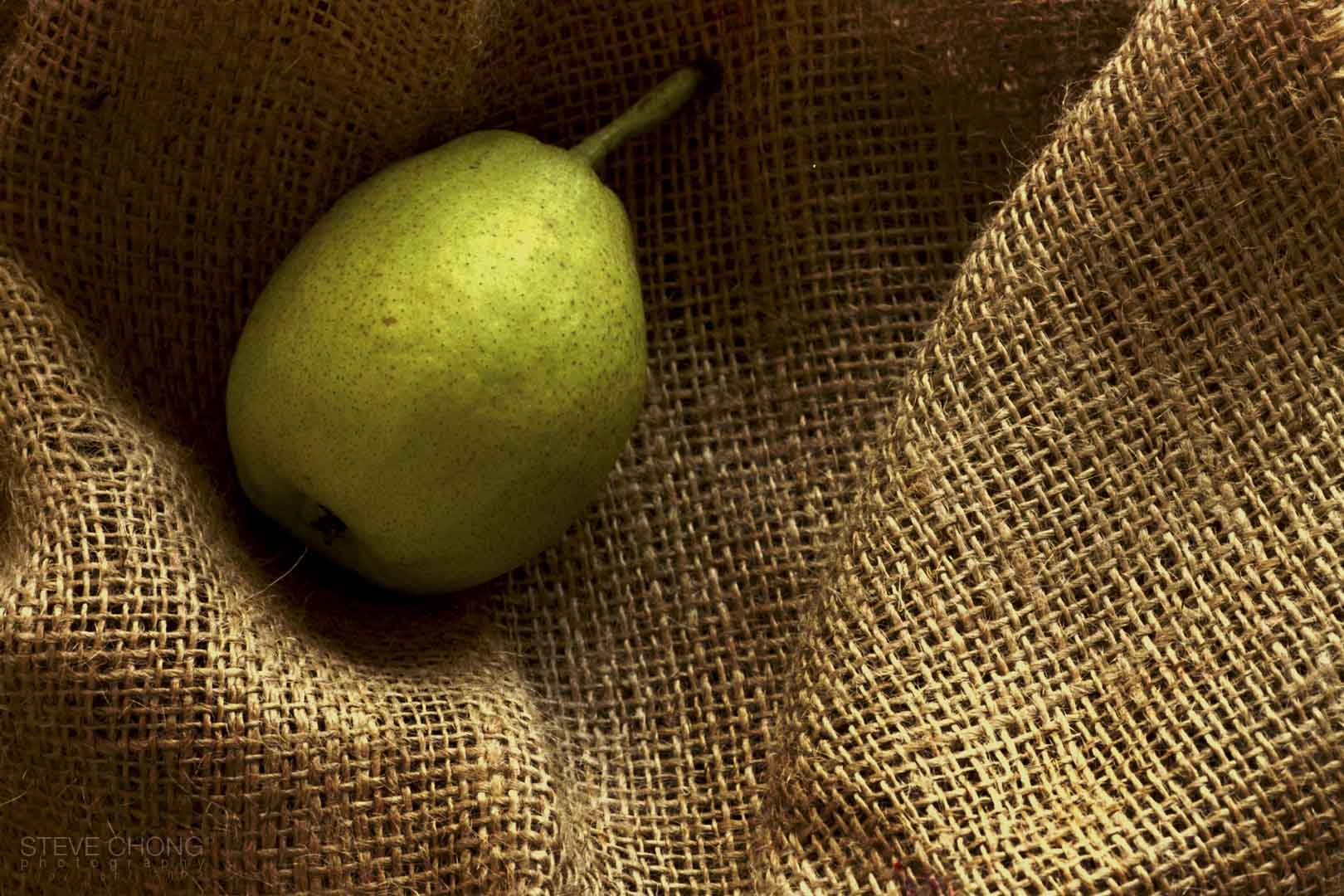
Shooting still life, I continued to explore the application of light, shadow and texture; this time I chose pears and paired it with sack bags. Two ordinary subjects that were quite challenging to photograph.
For the setup, first, under the big window in the studio, I placed the sack on the tray and carefully folded the “V” shape of the wave pattern.
Then, the pear was placed, not standing it upright, but letting it “lie” as if it was asleep.
Then, adjust the wave pattern in order to produce the effect of light and shadow, which can make the composition more three-dimensional.
With the refraction of light, I found that the surface of the pear had an annoying reflected light, so I added a polarizer and rotated it to cut out the reflection.
To enhance the warm tones, I used 85 warm color filters.
Some friends asked, when the filters were added, wouldn’t the exposure time become longer? When shooting still life in the studio, everything is under control; even if the exposure time is a few seconds, it will not be a problem.
As a matter of fact, when shooting still life with a large format camera, some compositions even use exposure times of up to tens of minutes, and the faint light produces a very soft effect with amazing final results. However, when shooting long exposures digitally, it’s always a pain to see how the sensor is being “wear and tear” that comes with long exposures.
Back to the composition of the pear, I chose an aperture of F5.6, enough depth of field to get everything sharp and is one of the sharpest apertures of the lens.
After scrutinizing all the elements carefully, I then pressed the shutter. I must say I was quite satisfied with the final result. From making this shot, I have a deeper understanding of light and shadow and of course, texture.